How to Keep Your Outdoor Room Warm Through a Waikato Winter
February 27, 2026
Why Waikato Winters Catch Outdoor Rooms Off Guard
Hamilton and the wider Waikato region enjoy some of New Zealand's best summer weather - long warm evenings, clear skies, and the kind of conditions that make outdoor living genuinely brilliant. But come June and July, temperatures regularly drop to single digits overnight, morning frosts aren't unusual, and the region's notorious dampness makes it feel colder than the thermometer suggests.
For many homeowners, this means a covered outdoor space that gets used constantly from October through April, then sits gathering leaves for four months of the year. That's a lot of downtime for what's often a significant investment. The good news is that with the right heating approach, you can realistically extend your outdoor season by two to three months on either end - and in mild spells, you might find yourself out there all year round.
The Three Main Options for Outdoor Heating
Not all outdoor heaters are created equal, and the type you choose makes a big difference to both comfort and running costs. Here's a clear breakdown of the main options available to New Zealand homeowners.
Electric Infrared Heaters
Infrared heaters work by warming people and objects directly, rather than heating the surrounding air. This is a critical distinction for outdoor spaces, where warm air simply drifts away the moment a breeze picks up. Because the heat is radiant - similar in principle to warmth from the sun - you feel it immediately and it doesn't disappear the moment someone opens a gap in the blinds.
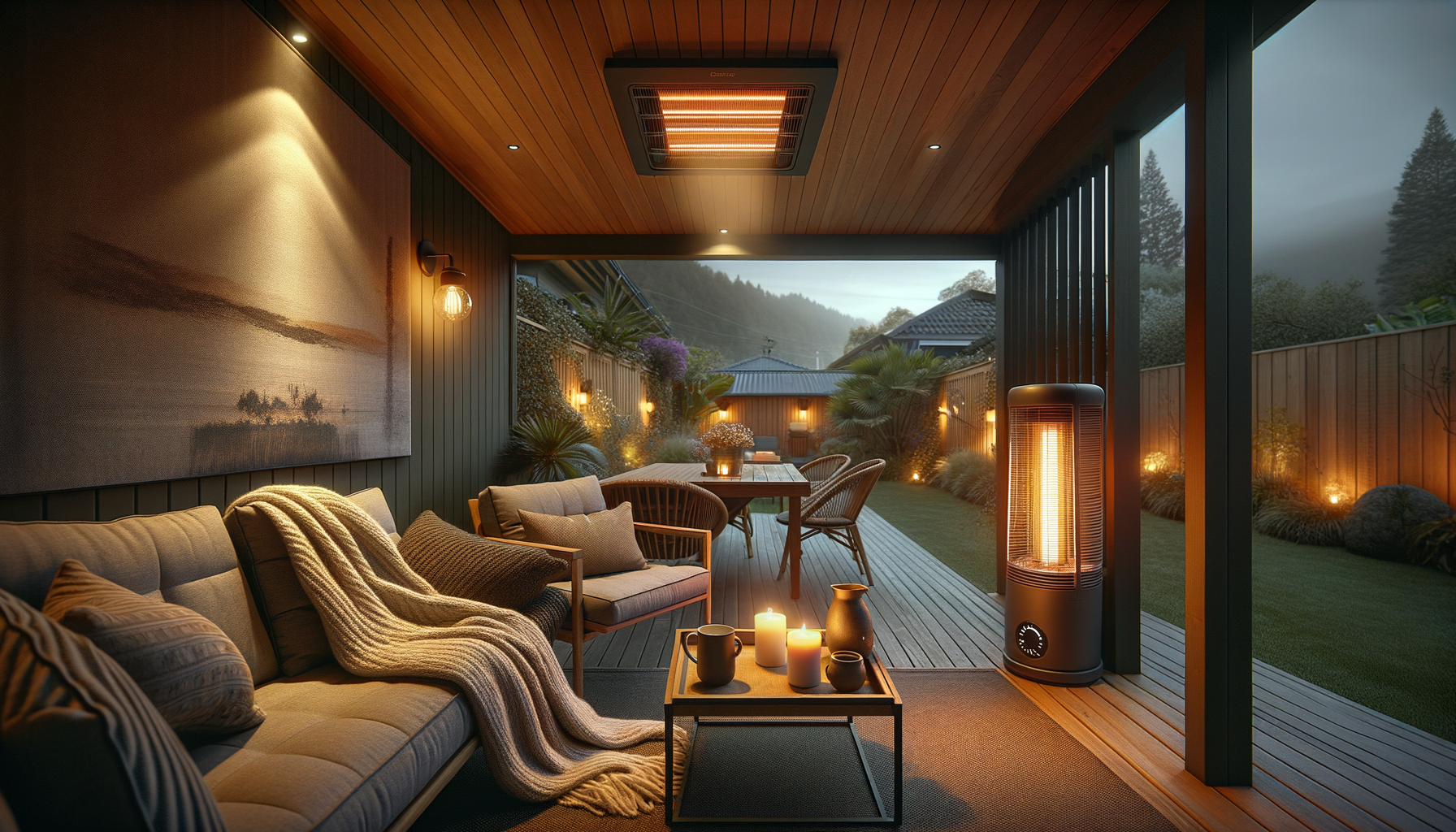
For covered outdoor rooms in the Waikato, ceiling-mounted or wall-mounted electric infrared units are one of the most practical choices. They're clean, quiet, and easy to control. Look for units with an IP rating of at least IP55 for outdoor use - this tells you they're built to handle rain splash and humidity without becoming a safety hazard.
Running costs vary depending on the wattage of your unit and how often you use it, but a 2,000-watt infrared heater running for three hours an evening will use about 6 kWh of electricity. At current New Zealand power prices (around 30 cents per kWh as of 2024), that's roughly $1.80 per session - very manageable for occasional use.
Gas Patio Heaters
Freestanding gas patio heaters - the tall mushroom-style units you'll recognise from cafes and restaurants - are a popular choice because they're portable and don't require any installation. They run on standard LPG bottles and produce a decent amount of heat in a circular pattern beneath the head of the unit.
The trade-off is that they're less efficient than infrared units in breezy conditions, they require ongoing bottle replacement or refilling, and they're not ideal for spaces with low ceilings or any overhead coverage. If your outdoor space is fully open to the elements, a portable gas heater can work well. But for covered outdoor rooms where permanent installation is an option, fixed electric infrared tends to outperform them on both convenience and heat delivery.
Outdoor Fireplaces and Fire Pits
There's something undeniably appealing about a real fire. Outdoor fireplaces and fire pits have become increasingly popular in New Zealand gardens, and it's not hard to see why - they provide warmth, light, and a natural gathering point that no electric heater can quite replicate.
Wood-burning fire pits and chimeneas work well in open garden settings, but Waikato's occasional burn restrictions (particularly during dry summers) are worth keeping in mind. If you're installing a permanent outdoor fireplace as part of a covered structure, you'll want professional advice to ensure adequate ventilation and appropriate clearances from combustible materials - this isn't an area to guess at.
Bioethanol fireplaces are a smokeless alternative that looks beautiful and works without a flue, making them more flexible for covered spaces. They don't produce as much raw heat as wood fires, but they're genuinely functional as a supplementary heat source and create wonderful ambience.
Getting the Positioning Right
Even the best heater will underperform if it's positioned poorly. A few things to keep in mind:
- Ceiling height matters. Infrared heaters work best when mounted 2.1 to 2.4 metres above floor level. Too high and the heat disperses before it reaches you; too low and it can feel uncomfortably intense when seated directly beneath.
- Cover your main seating area first. Rather than trying to heat the whole space, focus heat sources on the zone where people actually sit. One well-positioned 2,400-watt heater covering a 4-5 square metre seating area will be far more effective than two underpowered units spread across the whole space.
- Think about your blinds and screens. An outdoor room that has drop-down blinds or screens on at least two or three sides will retain heat dramatically better than a completely open pergola. Wind is the enemy of outdoor heating - even a light breeze will carry warmth away faster than any heater can replace it. Enclosing your space, even partially, is one of the most effective things you can do.
- Don't forget the floor. Concrete or tile underfoot draws heat out of your feet and makes the whole space feel colder. An outdoor-rated rug under the seating area makes a genuine difference to perceived warmth.
How Many Heaters Do You Actually Need?
A rough starting point used by heating specialists is to allow approximately 1,000 watts of infrared heating per square metre of outdoor space you want to heat. So a 12-square-metre outdoor dining area would ideally have around 2,400 to 3,000 watts of installed heating capacity - achievable with one or two ceiling-mounted units.
This calculation changes significantly depending on how enclosed your space is. A fully covered outdoor room with three sides of screening retains heat much more efficiently than an open pergola, and you'd likely get excellent results with lower wattage. An open-sided structure in an exposed position might need more.
If you're unsure, it's worth talking to an electrician or heating specialist who can assess your specific setup. Getting a professional recommendation upfront is far cheaper than buying undersized heaters and having to replace them later.
Safety Considerations You Shouldn't Skip
Outdoor heating involves a few non-negotiable safety basics that are worth spelling out clearly:
- All electrical outdoor heating must be installed by a registered electrician. This isn't optional in New Zealand - it's a legal requirement, and for good reason. Outdoor installations are exposed to moisture and require appropriate weatherproofing, correct circuit protection, and proper earthing.
- Check clearances for any overhead heaters. Each product has manufacturer specifications for minimum clearance from surfaces above and around the unit. Follow these precisely - they're not conservative guidelines, they're minimum safe distances.
- Keep combustibles away from gas heaters. Outdoor blinds, fabric cushions, and timber structures all need to be well clear of any gas heater flame or heat output.
- If you're in a multi-unit complex or rental property, check with your body corporate or landlord before installing any fixed heating equipment.
Making the Most of What You've Got
Heating technology is only part of the equation. A few lower-cost additions can make a surprising difference to how comfortable your outdoor space feels on a cool Waikato evening:
- Outdoor cushions and throws. Have a basket of blankets near the door. It sounds basic, but it works - and your guests will appreciate the gesture.
- Candles and ambient lighting. Both create a psychological sense of warmth, and they extend the feeling of cosiness well beyond what any heater can do alone.
- A hot drinks station. A bench with a kettle, mugs, and a selection of teas or a coffee machine turns a cool evening outside into something genuinely enjoyable rather than something to be endured.
- Strategic windbreaks. Even a simple trellis with climbing plants on the windward side of your outdoor space can reduce wind chill substantially. In the Waikato, prevailing winds tend to come from the south and southwest in winter - worth knowing when planning where to add screening.
The Honest Reality About Outdoor Heating
It's worth being clear-eyed about what outdoor heating can and can't do. A well-set-up outdoor room with good coverage, effective windbreaks, and quality infrared heating can be genuinely comfortable down to around 5 or 6 degrees Celsius. Below that, most people will find it a stretch, regardless of how powerful the heaters are.
But in the Waikato, overnight frosts are relatively infrequent in June and July, and daytime and early evening temperatures through winter regularly sit in the 12 to 16 degree range - perfectly manageable with the right heating and screening setup. That means the bulk of the Waikato winter is genuinely workable outdoor living weather, if your space is set up for it.
The homeowners who get the most from their outdoor spaces in winter tend to be those who've thought about heating, enclosure, and comfort together as a system - not those who've bought the biggest heater they could find and hoped for the best.